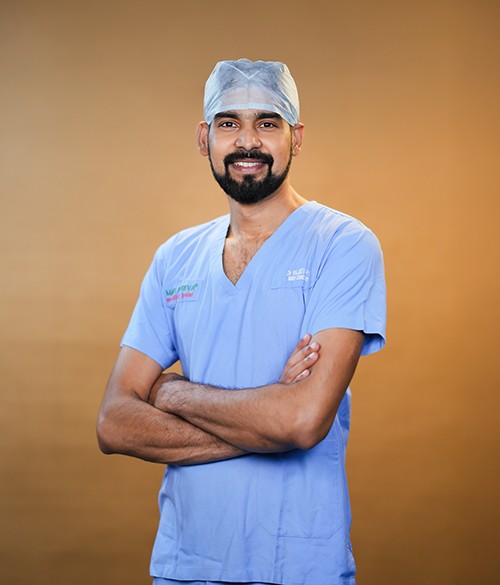
Dr. Rajeev P B is a renowned Senior Consultant Orthopaedic Surgeon with over 14 years of extensive experience in managing a wide spectrum of musculoskeletal conditions. He holds an MS in Orthopaedics, a Diplomate of National Board (DNB Ortho), and a Diploma in Orthopaedics, establishing a strong academic and clinical foundation in the field. Further enhancing his expertise, he has completed advanced fellowship training from reputed national and international institutions. Currently practicing at Marsleeva Medicity, Palai, Dr. Rajeev is widely recognized for his proficiency in joint replacement surgeries, arthroscopic procedures, and trauma care. He has successfully performed numerous total knee and hip replacements, enabling patients to regain mobility and return to active, pain-free lives. His commitment to minimally invasive techniques ensures less pain, faster recovery, and shorter hospital stays for his patients. Dr. Rajeev’s clinical interests also include sports injuries, ligament reconstructions, and complex fracture management. His patient-first approach, clear communication, and evidence-based treatment methods have earned him a strong reputation among peers and immense trust among patients. Beyond the operating room, Dr. Rajeev remains dedicated to continuous learning and innovation. He has numerous research papers to his credit in the field of Orthopaedics and actively participates in national and international conferences to stay at the forefront of medical advancements. Patients appreciate his warm, approachable demeanor and meticulous attention to detail, combined with his commitment to delivering the best possible outcomes. Whether you're dealing with chronic joint pain, a sports injury, or a traumatic fracture, Dr. Rajeev P B offers comprehensive, compassionate, and cutting-edge orthopaedic care to help you move better and live healthier.
John Doe
Happy Patient
"Whether you're dealing with joint pain, sports injuries, fractures, or any other orthopedic condition, our comprehensive approach ensures you receive the highest standard of care from diagnosis to recovery. Welcome to our welcome, where three passionate orthopedic doctors have come together to bring you the best in musculoskeletal care. Our clinic is founded on the principle of providing top-notch expertise, compassionate care, and innovative solutions."
A patient should consider joint replacement surgery when joint pain, stiffness, or deformity severely limits daily activities and quality of life, and when non-surgical treatments such as medications, physiotherapy, and lifestyle modification no longer provide relief. It is usually advised for advanced osteoarthritis, rheumatoid arthritis, avascular necrosis, or post-traumatic arthritis where joint surfaces are damaged. The goal is to relieve pain, restore function, correct the deformity and improve mobility. The decision should be made after careful evaluation by an orthopedic specialist, considering the patient’s age, activity level, and overall health.
The recovery process after sports injury surgery varies with the type of procedure and individual healing response. After arthroscopic ACL reconstruction for knee ligament injuries, rehabilitation usually takes 6 to 9 months, focusing on regaining motion, strength, and stability before returning to sports. For arthroscopic meniscal repair, recovery generally requires 3 to 6 months, with early protection of the repair and gradual progression to full activity.
In arthroscopic rotator cuff and labral repair for shoulder instability, recovery often takes 4 to 9 months, involving a period of sling immobilization followed by physiotherapy to restore range of motion and shoulder strength. Overall, adherence to a structured rehabilitation program and guidance from the orthopedic and physiotherapy team are essential for safe and complete recovery.
Pelvi-acetabular fractures involve the pelvic ring or the acetabulum (the socket of the hip joint). These fractures are usually caused by high-energy trauma, such as road traffic accidents or falls from height. They differ from other fractures because the pelvis houses vital organs, major blood vessels, and nerves, and the acetabulum forms part of the hip joint, making these injuries potentially life-threatening and complex.
Management differs as it requires a multidisciplinary approach initially focusing on stabilizing the patient (control of bleeding, treating associated injuries), followed by precise imaging and specialized surgical fixation to restore pelvic stability and joint congruency. These fractures are fixed only by orthopedic surgeons who have specialized training in pelvi-acetabular fracture fixation, as the procedures demand advanced anatomical knowledge, surgical skill, and specialized instrumentation. Rehabilitation is gradual and closely monitored to prevent complications such as stiffness,
Prevention of joint and sports-related injuries involves proper conditioning, technique, and precautions. Regular warm-up and stretching before activity improve flexibility and reduce strain on muscles and joints. Maintaining muscle strength and balance, especially around major joints like the knee and shoulder, provides better support. Using appropriate footwear and protective gear, avoiding overtraining, and allowing adequate rest and recovery are essential. Practicing correct sporting techniques and gradually increasing training intensity help prevent overuse injuries.
Maintaining proper nutrition and diet is equally important, as it supports muscle repair, bone strength, and joint health. A balanced diet rich in proteins, calcium, vitamin D, and essential nutrients enhances recovery, performance, and resistance to injury.
Additionally, specialized training under professional supervision ensures that athletes learn the correct methods and safety measures. Proper guidance while participating in specific sporting events helps tailor training to the sport’s physical demands. Consideration of the playing surface, whether synthetic or natural, is also crucial since it affects impact forces, traction, and the overall risk of joint and ligament injuries.